Friday, July 27, 2012

Estuary

A week ago we took a trip down to Ada Foah, at the mouth of the Volta River. There are actually two little towns here, joined by tourist camps and small hotels. We booked a great room in a guest house. Amongst its amenities, most important of which was allowing our dog, was our own sitting room (separate from the bedroom), the use of a fridge and kitchen, and a covered back deck with comfy lounge furniture. Here we could sit out and read, and it was here we took our breakfast each morning. Though the guest house is in the heart of Ada Foah — most camps and hotels are directly on the beaches — the backyard overlooked 'vacant' lots, wooded with palm trees.


The sandy point

The main attraction is the estuary where the Volta River meets the Gulf of Guinea. The river comes at the gulf at an angle, rather than perpendicularly. This results in a long sand spit (several kilometres) with the gulf to the south and the river to the north. So while the Atlantic continues its merciless pounding on one side, calm waters welcome on the other. And as a tidal pool, the river is safe, that is, free of nasty, fresh water parasites. It's also free of crocodiles. (There are several islands in the river here, one named Crocodile Island, though they have long ago been driven out. On another island is a rum distillery. But that will be another post.)

The banks of the river are populated by a few hotels and many large vacation homes owned by rich Accra residents. But this is the off-season (notice the brooding sky above) so we pretty much had the run of the place. Because of the calm waters of the estuary, sailing and boating are a major attraction. There is even a sailing club. The fact it is safe to fall overboard (drowning excepted) is also an attraction.


The calm of the river
The contrast between the river and the ocean could not be more pronounced. All along the coast of Ghana the surf is unrelenting, and guidebooks constantly make much of the dangers of the undertow. There are a few places where I've ventured to take my feet of the ground and do a little body surfing. This was not one of them. The undertow here was fantastic. A few times, standing, feet planted firmly in the sand, the receding waves flipped me over.


The tempest of the gulf
Wherever we go, Chai provides a somewhat welcome distraction from the calls of 'obruni'. Without her, people stare at (and call out to) the two white folk. With her, we sometimes wonder if we humans are noticed. She loves the surf, and the best game is chasing a plastic bottle weighted with a little sand. But we always soon draw a crowd.

Tuesday, July 3, 2012

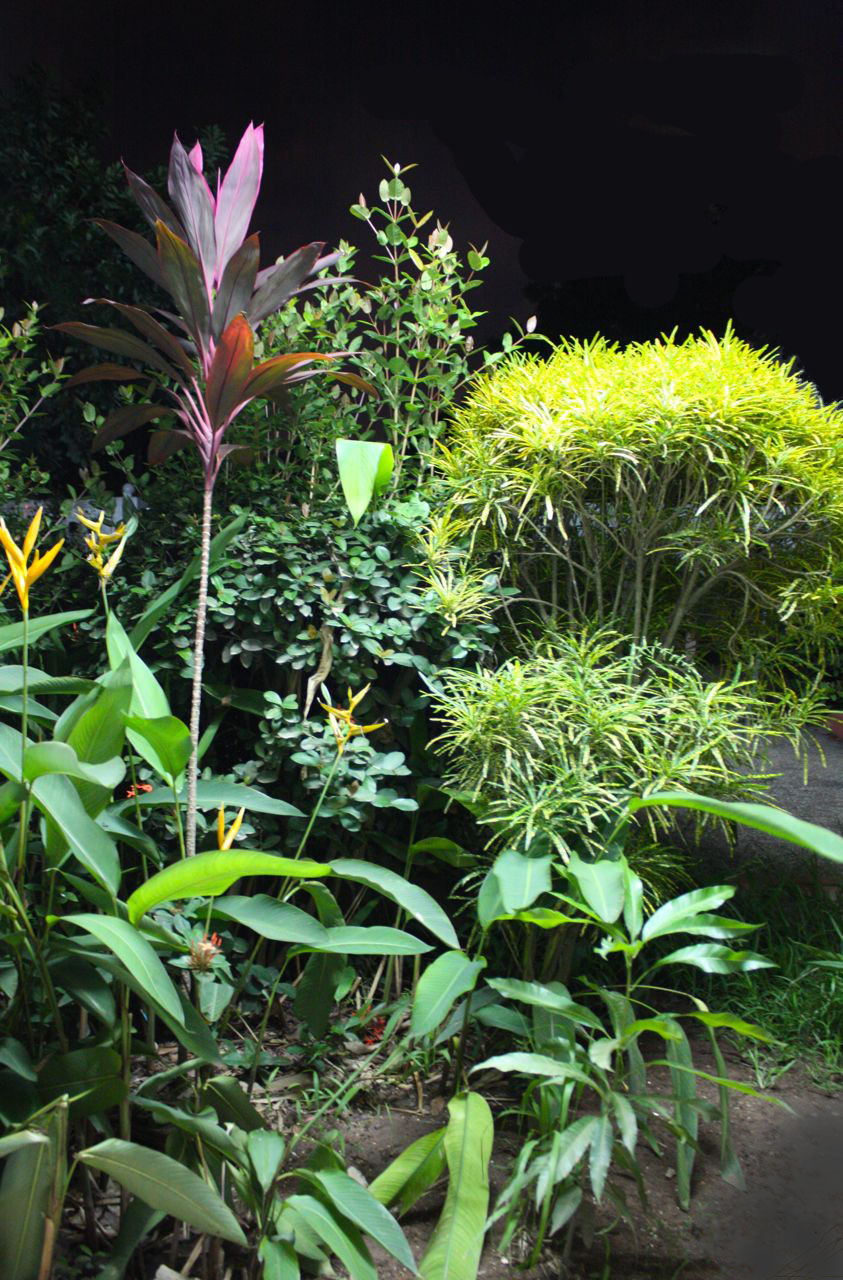
Night Garden


I took this photo a few evenings ago. I was sitting out on our verandah, enjoying both the night air and, surprisingly, the absence of mosquitoes. I looked up and saw this little view. The garden was framed between two white plaster pillars, which I've avoided in the photo, and lit from above by a fluorescent tube. I like the unnatural feel of the light. It has the overly crisp appearance and stark contrast typical of a flash photograph, but the source of light is above rather than in front.

In the photo you can see thin leaved croton on the right (we also have broad-leaved varieties), ginger lily in the left foreground (they look a bit like birds of paradise), and ti or good luck plant (the tall red plant) on the left. 

From where I sit, and took the photograph, we are sheltered from the elements. We have spent many pleasant hours, both during daylight and dark, reading, chatting, eating, and looking out at our little garden. This has been especially enjoyable during the rainy season, when we can watch rains, light and heavy, dance on the leaves of the garden.

Friday, June 29, 2012

A contradiction

I took this photograph from the roof of Elmina castle. What was before the camera is in stark contrast to what was behind and below. The tranquil blue of the Gulf of Guinea, the soft colours atop the whitewash and the rounded plaster of the fortifications tell us nothing of the real history and purpose of this creation.


Despite the name, the castle is really a fort. Many forts were built along the coastline of what is now Ghana (and its neighbours). Typically these housed armed garrisons, a governor and other official representatives of some European nation, and the support staff. They also housed, over the years, tens of thousands of captured Africans, bound for the West Indies, the Americas, Europe, and even the East.

Below where I stand are the separate dungeons for men and women, the rooms where punishment and death were meted out and where women were selected for rape, and the passageway to awaiting ships.


The weekend in Elmina was full of these contradictions: modern poverty and a luxurious resort, putrefied garbage and hot showers, hand pushed carts and and air conditioned buses, tranquil views and damp dungeons.

Thursday, June 28, 2012

Not all trees are created equal

Is everyone tired of looking at flowers yet?

I think I've failed to mention this in the blog, but we've moved back onto campus. This happened in March. An opening came up, we were offered it, and off we went. This is my seventh place since arriving 18 months ago (Anna-Marie's fourth; she says her next move will be to the airport). But despite the itinerant feel of it all, we are glad to be back on campus. We are surrounded by grassy fields instead of red dust. And of course all the flowering trees.

The move meant we gave up our coconut tree which was just starting to product ripe coconuts. But we gained two new trees of interest.

Our house is a complex of four small units clustered around a courtyard. The majority of the courtyard is a parking lot, but the perimeter is beautifully planted with thin leaved croton and ginger lily and other tropical plants. Our new home also has two flowering trees, though the flowers are not the main attraction. In one corner of the courtyard is this:


Anna-Marie reported she may actually be getting tired of avocado
These avocados started to ripen in mid-April and while I was in Canada they were in full production. They are huge, about the size of a baby's head, and tasty. The only problem was keeping them for ourselves — though it turned out there was more than enough to go around. We kept 'catching' people outside the courtyard whacking the branches with sticks to knock the ripe ones down.

We had the same problem with the tree at the foot of our driveway:

Small, sweet mangoes
While pineapples are in season all year long, avocados and mangoes are seasonal. Both are available all year round but in April you start seeing more and more of them in the markets, and last April, driving through the country with Ralf and Fortune we passed kilometre after kilometre of stands lining the highway. And each stand is selling a different kind. There are hundreds of varieties of mangoes — in this sense they are like apples — and dozens are available in Ghana. Our tree produces a smallish version, about 10cm in length. 

Wednesday, June 27, 2012

Another pair

Don't worry. I will soon get tired of posting pictures of anonymous trees. Mostly I just like keeping my sister hunting down the names. And just so you don't think I'm being lazy, she really is doing me a service. She has sent a few links, notably a good one for flowering trees on a flickr site. But I've been unable to access it from here. 

As I point out every month or two, the internet here is not nearly as reliable as back home. In addition to power outages, the servers just going down, and a few thousand students trying to download a gazillion movies at once, the ICT department here shapes our internet signal and blocks various sites. The blocking of sites is not a direct form of censorship; it is intended to limit wide bandwidth consumption from what are deemed non-academic sites. 

To this end, I returned from Canada to discover that I can no longer watch youtube. I will have to call the ICT and point out that not everything on youtube is stupid human and animal tricks. In the past few weeks I've been sent three links of an academic nature to youtube that I've not been able to watch. Flickr may be caught in the same net.

To the trees!

Again, I offer you a pair. The first is a lone specimen, located at one end of the track field.


The second tree is also not very common, though I've spotted more than one. In this picture it is just shy of full bloom, so the white pyramids will be larger and more vibrant in a day or two.


It is also located just south of the track field. Both were shot early in the morning (around 6:30am) while out for our early morning dog walk. I usually get up at 6:00am, make coffee, and head out the door by about 6:15am. This is a wonderful time of day — even on hot days this will be a pleasant time to hoof around campus. That is important for my own personal comfort, but it also means I don't short change Chai on the morning walk. But by 7:00am on a sunny day it will start to get unpleasant. Especially if I am marching around with a cup of hot coffee.

Sunday, June 24, 2012

I give you two trees

Because the internet was down yesterday I couldn't post to the blog. So today I send you two trees.

The first tree is quite ubiquitous — from my office window I see two, and they are common around campus. The tree gently snows down delicate white flowers. These are not large, about 5-8 centimetres long. This means, while the trees are covered in them, they are difficult to capture in photographs. Whenever I try to get a good chunk of tree in, the flowers just disappear.

Millingtonia hortensis (Indian Cork Tree or Tree Jasmine)
Most of the tree flowers have very little or no scent. But these flowers have a heady aroma, thick and sweet, reminiscent of night blooming flowers. In bloom, the tree is covered with these small inverted flowers which at their peak gentle drop straight to the ground. 


This makes for a delightful carpet of white around each tree.

This second tree is more unique. I've only encountered one so far. However, an interesting aspect of the trees here is that I can walk by a tree for months without change and suddenly, one day, it has become a flowering tree, pushing out some dazzling array of yellow, red, or blue.

Callinadra surinamensis (Pink Powder Puff)
This is one such tree. I walk under it several times a week, on my way to the night market. Then two weeks ago the tree was transformed.


These flowers seem more suited to a garden plant than a tree. But there they are, starting at about two metres off the ground, facing up from the branches, and climbing to the tree top. This is the pleasure I take in the flowering trees, the sudden surprise of transformation, an unanticipated change from one day to the next.