Sunday, October 9, 2011

A dog’s life on the road

We left Canada on August 2: two humans, a dog, and a pile of baggage. Since then, a number of people have asked about Chai's experience of the flight. We asked her to share her thoughts about air travel but she's kept her cards close to her vest, though perhaps her yawning and butt-licking are to be understood as editorial. 

There was a fair bit of stress involved in shipping Chai, mostly because of unknowns about what documents we needed and what fees we were to pay, where, when, and to whom. Even obtaining a crate with the correct dimensions and characteristics had us worried. Everywhere we turned we got different stories about the shipment process.

The worst moment was the call made to the airline one week before departure to confirm Chai as baggage. An extremely ill-informed (as it turned out) employee told us pets weren’t allowed on our flight. I immediately called my travel agent, we both called the airline again, she called a manager at the airline. Everyone now said the dog was allowed, but the confirmation would not show up until the next day. This led to a sleepless night until it all got straightened out the next day.

Another example of blood pressure elevating pre-flight problem occurred a few weeks before flying when I noticed an obscure reference on a website stating that all pets brought into Ghana would require an import permit, only obtainable in person two weeks prior to arrival, from the Chief Veterinarian in Accra. Seriously??? 

The Consulate in Toronto had never heard of such a requirement and I could find nothing online or anywhere else about a Chief Veterinarian. An email to the National Veterinary Service went unanswered.

Before departing we settled on a country-specific strategy for flying with Chai: In all countries we will smile and be nice; if absolutely necessary in Canada or Holland, we will endeavor produce tears, quivering lips, and polite, earnest answers directed at resolving whatever roadblock is in our way. In Ghana, however, our plan is to skip the tears, maintain our eager courtesy, and dispense whatever hard cash is needed into whichever hands appear most useful.

It turns out that we did require an import permit to bring the dog into Ghana and - happily - we are able to obtain it at the airport without incident. We even got an official receipt for the money that was handed over, meaning no palms were greased during the importation of our dog. The funds we paid covered the import permit plus our fine for not having secured the permit before arriving. 

Chai's treatment during travel seems to have been excellent. As far as we can tell, she arrived sans trauma – if a little disoriented and badly in need of stretching her legs – in an unsoiled crate after about twenty hours apart from us and more than 27 hours after we left Waterloo. She did, however, release what may be the longest single stream of urine ever deposited on a sidewalk outside of international arrivals at the Accra airport.

Before
After

Check-in at the Toronto airport took over an hour, with much shuffling from self-serve kiosk to baggage check-in to payment counter. Chai even had her crate x-rayed in a special area. Her crate had multiple labels, documents and objects attached — “live animal”, “this end up”, a veterinarian's certificate, her passport, ownership claim, flight information, and a bottle of water and a bag of kibble.  

After a long wait and repeated calls to get the ground crew to fetch Chai, two workers in overalls appeared, sans dolly. In fact, frankly, they looked like they had lost the dolly on the way up from the airplane. Chai was tucked into her crate and the crate was then perched upon a regular suitcase cart. With each move of the dog or the cart, the crate rocked from side-to-side. Our last Canadian glimpse of our dog was of her literally teetering toward Africa. 

On arrival in Accra, one of our bags is missing. It turns out that it is just sitting on the ground on the very far side of the baggage carousel. But also missing is our dog.

So while we try to watch over our claimed bags and hunt around for the missing bag - this involves standing next to each other and shouting to be heard because our fellow passengers are unruly and loud - we also try to figure out what has become of Chai.

We noticed a commotion over where the baggage carousel enters the building and saw three baggage handlers struggling to lift the crate onto the belt and jam it through a low opening in the wall. With assistance from the inside we manage to squeeze the crate into the building. Then, after banging around our dog, three arms were extended through the opening and we were commanded to deliver "dash" into their eager palms, a tip for their good work. Or as I put it, for merely doing their job poorly. 

Now picture this: Five bags ranging in size from merely large to dauntingly massive along with one large dog crate are loaded onto three carts steered by two tired and disoriented yet determinedly polite Canadians are sideswiped and slammed by other travellers intent on squeezing their carts through the throngs and being first out the door. It is the closest we have ever been to being in an actual roller derby and, unbeknownst to us, an experience that also anticipates what its like to be in traffic in Accra. 

We also have a growing posse of local "help" who surround us and cause us to swell into a knot of people who surround a nucleus of carts, which, while very useful for getting through the crowd also fosters a feeling that we are as freaky as an arriving circus. At the exit to the building we are greeted by Mr Lartey and another driver from the University — this one with a pickup truck with a crew cab.

Outside the building the night air is thick and filled with scent and sound. As soon as we leave the building Chai is released from the crate. Now we are a real sight. Two obrunis, a big black dog, three carts of luggage, and three, four, five, six helpers. We load the luggage into the bed of the truck and five of us get into the truck along with Chai. Before we get in I give a tip to they guy who helped with the cart, and the rest of our accumulated posse want a little something. After all, they explain, they kept the crowds back from us as we made our way from the terminal to the truck.

Into the night and the city and Ghana we drive.

Saturday, September 10, 2011

Why My Parents Rock and Other Delights

The head of the philosophy department has extended a wealth of useful information to help us adapt to Accra. One gem is Milton Sterilizing Fluid, which is useful for cleaning vegetables that you might not want to peel because of nutrients lost with the discarded skin or that you can’t peel, such as lettuce. Basically, the stuff makes it possible to have salad – and salad is for sure a delight. The fluid is intended “for sterilizing baby bottles and teats without boiling” and claims to “kill all known germs including thrush.” The only thing in Milton Sterilizing Fluid is sodium but a light rinse removes any taste of it. An alternative is to dip produce in a dilute bleach solution and, well, ick to that.


You can find containers of toothpicks on each table in the guesthouse dining room. Their label announces that they are beautiful and practical. I had never thought of this before but why yes, indeed, toothpicks are. I mean, practical I get right away. But have you ever really looked at a toothpick? It’s a dandy – and delightful – example of minimal, streamlined and simple design aesthetic married to function.


In a place where electricity is a kind of random event, any time you flick a switch and power up a fan, a light, or a burner brings a sense of delight. There are two advantages to the switch with a little light;  it both tells you that power is coming to the switch and reminds you that power is coming to the switch. 


This particular switch turns on the small hot water tank hidden in a bathroom cupboard. There seems to be no temperature control on the tank, so five minutes of power in morning provides (literally) scalding hot water for a shower and regular hot water for the rest of the day. As cheesy as this sounds, the light is a delight, reminding us to not waste a precious commodity by keeping unused water unreasonably hot. (BTW, the down position is on over here.)

Getting mail is always a delight, but you might need some back-story for why this particular piece of mail moved us from mere delight to something closer to ecstasy. See, we don’t use paper towels. All our mopping up is done with cloth that can be re-used. Here, absorbent cloth is difficult to locate and, when you do find it, distressingly expensive given its poor quality. So I sent a distress signal to my parental units and in mere weeks received a fat bundle of permeable delight. (Thanks folks!)

Sunday, August 28, 2011

A dog's life


Want to know what its like to be a foreigner walking in Accra? You are stared at by friendly but curious people who often return your hello with a generous smile. Want to take the attention off yourself? Simple: Walk with your large black dog and then, frankly, you could be a six-legged fire-breathing purple person for all anyone would know.
Item 1: It’s hard to be certain but I think the puppy was probably 5 or 6 weeks old. It was so tiny that it fit easily in the palm of my hand. It had a few scabs and sores on its back, and it was so dirty that I spent a second wondering how many fleas were preparing to leap from its body to mine. When I set the little furball down on the ground it stayed in one place, didn’t try to explore or play, and seemed pretty lethargic. I inquired about the pup’s gender and what name the owner was giving it.  It’s a boy, I was told, but it won’t be given a name because the little thing is to be raised for food. It will live to be about 6 months old. Before I could stop myself I blurted that if the puppy was given a name then perhaps they won’t want to kill it  — a suggestion that produced an uncomfortable silence.
Item 2:  I don’t think we’re to blame for what happened, I really don’t. We both distinctly heard the woman make the hissing sound that means “come here.” Seriously, I’m telling you that she looked straight at the two of us and at our dog, Chai, and definitely, unmistakably, no doubt about it, hissed an invitation to us to come near. Yet when she realized we were, indeed, responding to her summons, the woman screamed — as in, use the full capacity of your lungs to create total frigging maximum volume vocal chord output type-screams  — then grabbed her infant and ran into her shop.  While she cowered behind her shop counter the shopkeepers on either side of her doubled over laughing. I’m pretty sure that they are going to spend the rest of the week taking the piss out of her for this. Not that any of her neighbours wanted to get near our dog either. 
Item 3: The Bush Canteen is a collection of shops and restaurants at the edge of campus. As we walked with Chai through its narrow, muddy lanes the woman behind the heavy grill cooking fish said that she would like to eat our red goat. Goat meat is pale and grey. Dog meat is red. Enough said.
Our red goat is not allowed in KK's house
 Item 4: Here is how walking your dog in Accra is just like walking your dog at home: Use a leash and walk with the dog on your left in standard heel position. Here is how it’s different than home (besides a poop bag being a superfluous accessory): Note that the Ghanaian walking toward you has begun to stare fixedly at the dog, and may even cross to the other side of the street. (If you are traveling toward a Ghanaian on a path that runs through a field, you have now put that person in a position of having to decide whether its riskier to stay on the path and face the dog or step into the grass and chance bothering a snake.) You call out, “Don’t worry, she’s friendly.” This invariably elicits two reactions. One of these is the offer of a relieved smile and, perhaps, a few questions about what type of dog this is, where we are from, and, from the deeply brave (I am not exaggerating) perhaps a little tentative patting.  The faces of those who remain fearful most resemble someone who has been invited to French kiss a starving piranha.  No chance, no way, no how, are they are coming anywhere near the dog.
On the other hand….
Item 5:  Yesterday I called to a man walking toward me that the dog was friendly. He replied, “Yes, I know.” Surprised, I asked him how it was that he was so sure. “Because,” he said, “if the dog was dangerous it would be in chains and shackles.” Eeeew-kay, roger that.
Neither chains nor shackles
 Item 6: I was walking toward the vegetable stand on Noguchie Link Road when I heard someone call out, “Is that a Labradoodle?” Huh? Even in Canada, where her type is relatively common, more often than not we have to tell people what Chai’s lineage is. I turned and found Shawn, a dog lover with a wide grin, leaning against his Toyota sedan. Apparently he had been playing a pick-up game when Chai and I walked past the basketball court. Shawn so wanted to confirm that he had correctly guessed Chai’s breed that he followed us in his car.  We spent a few minutes discussing the pros and cons of what Shawn called designer dogs before parting.
Designer dog
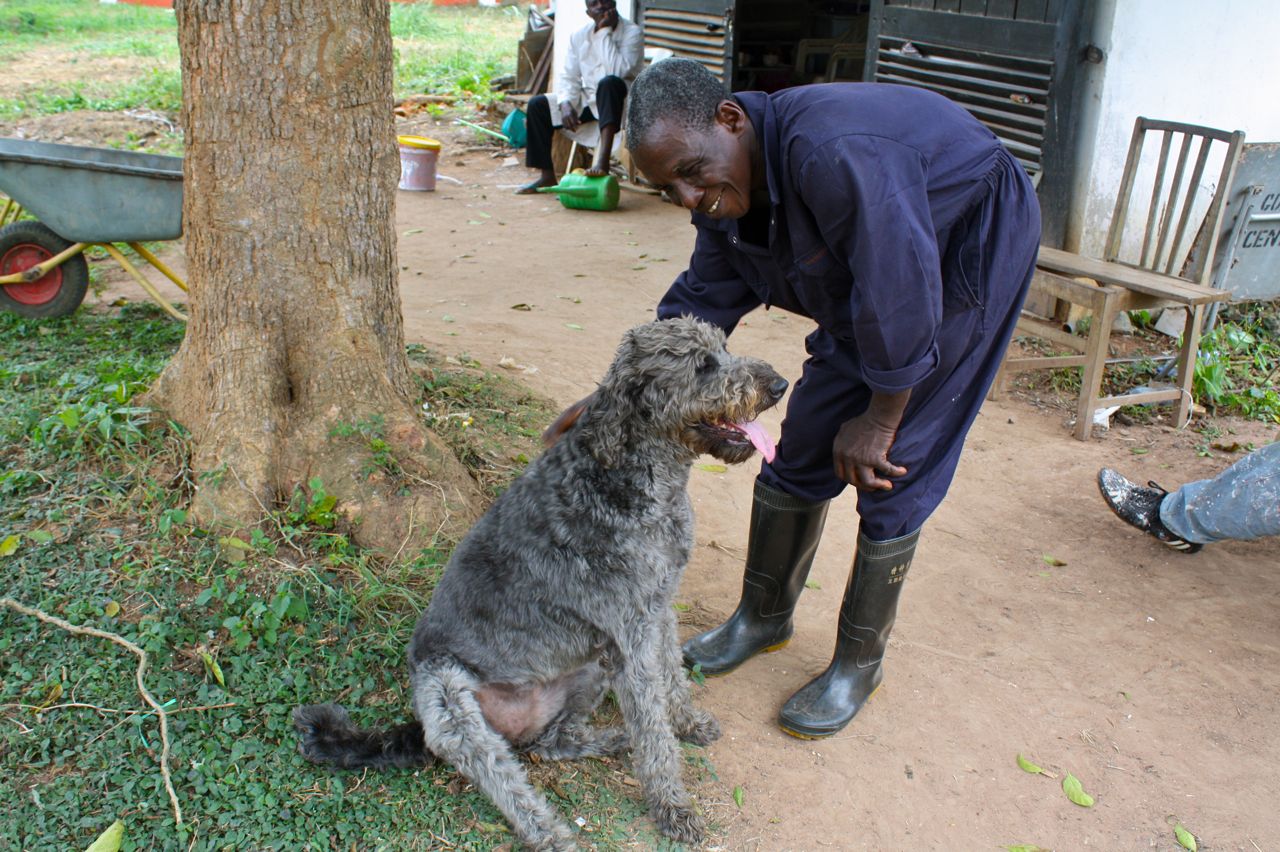
 Item 7: The first time Chai encountered the grounds keeping crew she bounded over to them with the same robust enthusiasm she extends most humans. And as far as I can tell, the dog understood that when they shrieked and hid between the polytank and the wall, that they were playing some sort of game. How fabulous! A game! That’s how I found them – three cowering adult men waving their arms and shouting in Twi, and one excited dog whose prey instinct was way, way whipped up. I explained she’s friendly, had Chai sit and invited the gents to shake her paw, which was all it took for them to fall in love. Now all the grounds crew and security guards ask about her when she isn’t around (“where’s my friend”) and insist on shaking a paw when she is.
Winning over Ghanaians one gardener at a time

Tuesday, August 23, 2011

The road to ecstasy is a rocky one

You probably already know about the potency of small surprise moments of extreme happiness ­– the ones where the level of pure joy and, well, unadulterated thrill are quite out of proportion to the thing itself. Yep. Just had one of those.
After weeks of sampling new flavours, de-mystifying how to cook unfamiliar produce, and generally being good sports about perpetually explaining and defending why, oh why, one would want to be a vegetarian, ladies and gentlemen, I give you – vigorous drumroll, please - the refined carbohydrate!!!!
Behold: The Catalyst
In Ghana, a donut is called a donut but a muffin is called a rocky. That’s because the surface of its crusty top is uneven, just like a pebbled surface.
The donut is lightly browned and heavily sprinkled with sugar. I’ve eaten both cake donuts and crispy, lovely, greasy deep fried donuts like grandma used to make (can you tell which one I like more?) and this one is nothing like either of those: it’s a bit rubbery, lacking oils in a way that causes me to wonder if it wasn’t actually baked, and not especially endowed with flavour. I wouldn’t say no to it again, but it’s definitely the pastry equivalent of the B-movie.
But, oh my, the rocky is my new best friend. At first I thought it was a cornmeal muffin because of its creamy yellow colour. Its interior is dense and moist, it’s not particularly sweet, and someone knew just how much vanilla is the right amount of vanilla. It has a properly crusty top. Indeed, the only thing wrong with the rocky is that it wasn’t delivered to me straight from the oven in the company of a decent cup of coffee.
Sold out by the time I returned to photograph.
I stumbled across this baked marvel outside The Basement, which is the tiny eatery that is all that remains of what at one time was the main student cafeteria before it was repurposed as a giant classroom. (The cavernous upstairs space can hold 1000 students and was where Carl taught his existentialism course in the spring semester to 140 students.) I hadn’t seen the stand there before but I certainly hope it’s a regular one. 
We also want to send a shout out to the folks at home who have patiently – and not! – waited for news since our departure three weeks ago today. We’ll tell you more about what we’ve been doing in future blog posts but for now suffice it to say that our house was not ready for us to move into as promised. We’ve been living at the same guest centre that hosted Carl while he was here in spring. We know a contractor has been secured to do the required work on our house but even if they finished it today we wouldn’t be able to move in until the polytank is installed and filled with water. We also understand that the words, “it will be done this weekend” are a kind of code that should be understood as, “I do not have a sweet clue when this will be done but I dream and pray that it is complete and perfect by this weekend.” Its only uncomfortable here in the sense that the in-between state that commenced in Canada is as extended as our desire to establish our home and routine here. 
The Central Cafeteria (it's still called that, even though it isn't)
 

Friday, August 19, 2011

New and improved!


Now with girls.
(Stay tuned for further updates soon — we've been busy.)

Monday, May 30, 2011

On the move

I leave today, to come back to Canada for two months. There has been much to do in preparation for this, not the least of which was finishing marking scripts. But I finished those yesterday morning. I also have to pack up all my belongings and shift everything over to storage where they will live for the two months. When I return at the beginning of August with Anna-Marie and our dog, Chai, we will be moving into a big fat house.

I was happy to stay on campus for the first five months while I started to get to know and understand the country. And part of me would be happy to continue to stay here. It is relatively quiet (but we are surrounded by students after all) and very green which, I'm sure, means less dusty during the dry season than many neighbourhoods I have been through. In January I was dusting surfaces in my office and rooms daily.

But housing on campus is a hot commodity and after struggling for two months to secure something I finally relented and started shopping off campus. Even this was difficult. The university has a housing office, for both on and off campus. And the staff there are tasked with sourcing apartments and housing off campus. But getting things organized here can be a challenge. For the first two weeks of February we performed a dance of missed appointments before I got the keys to the bungalow.

And after looking at a mixed bag of houses, I felt like Goldilocks (or worse, a prima donna foreigner): houses were too far, too noisy, too expensive, too falling apart, too still being built (with no real guarantee they would ever be finished), too lacking in water (as in had a toilet, but no sink, shower, or tub and wasn't connected to a municipal water supply), too small, or too big. Finally, I settled on too big. And a little further away than I would like, but manageable.

To live close to the university means either renting a house in dollars or renting very little house at all. Landlords that charge in dollars cater to rich ex-pats working for multinationals and NGOs, who clearly make more money than I do, when the monthly rent is more than my entire take-home pay. Dollar houses were never real contenders. However, the house with no water was. To give you a taste of what makes the grade after living here for five months:


Location, location, location. This charming little fixer-upper was within walking, or better, biking distance of the campus and a walk to and cab ride from one of the 'western' malls in the city — catering to foreigners these are the source of cheese, olives, chips, pizza flour, papadums, rice paper, etc. But it also had no water supply, and only a toilet and kitchen sink. Which makes sense when you consider there is no water.


The solution, to avoid bringing in carboys by cab, is to install what is called a polytank (the roof-top thing that blew a pipe in a previous blog entry). Then a truck comes and pumps the tank full. It turns out that most houses in Greater Accra operate this way, even those that are in neighbourhoods with water lines — in part, because the water lines are unreliable. And by either method the water is not potable.

The university was prepared to install the water tank and a shower and a bathroom sink and clean and repair and paint and even clean up the rusting scrap metal from the 'yard'. The second best feature of this house was the price. In fact, location and price were the only features. But I could afford more, so we pressed on.

After a second look at the house above we looked at two more. Both were too far to walk or bike to the campus or the mall, but I had been prepared for this all along. The second one had a good yard.


No, honest. This is a good yard.

I liked where it was. There were lots of little shops on the street and two mosques within sight. But the house was right on the street, and it was a busy one. Also, the place was in very sad shape. The living room had a Teutonic feel to it, complete with water damage and mold, just like in a real castle.


I also learned that, unlike in Canada, landlords here are not saddled with any sense that cleaning the property might help rent it. This saves much time and trouble.


This is a horizontal row of little jalousie windows that open onto a central hall. Rooms on both sides of the hall have larger jalousie windows opening onto the outside so the whole house may benefit from any cross breeze. Above the window is one of many giant cobwebs.

There are other oddities about renting in Ghana. Most rentals are for two years, many others for one year. But to rent you must pay the full one or two years rent up front. This is a real catch 22. It means that many people can never move, when you would have to save up three or four or six months wages to pay down. This is especially hard if you have been living for two years without paying rent out on a monthly bases, but not saving any money.

It also means that landlords are almost by definition absent. Once the money is handed over you probably will not see the person again until the one or two years is up. Especially when something goes wrong in the house. It is a given here that house repairs, even major ones like replacing a roof, are the responsibility of the tenant.

And in defense of the landlords, if a tenant has paid months in advance, there is less incentive to just pick up and move into the house of an extended family member when space comes available. This in the past has been a major problem and was the motivation for the cash up front policy.

On to the house I've rented.

Still further from campus and the mall, and more expensive, but quiet and secure, newly renovated and modern, attractive and large. Too large really, with four bedrooms, three bathrooms and garage. Friends can come and visit and they can bring their own car from Canada. 

From the front porch overlooking the okra patch and the caretaker's house

The house is a compromise. On the one hand, it would be good to live as Ghanaian as possible. On the other hand, I recognize that doesn't mean completely Ghanaian. My driver, Mr Larteh, has three children sleeping in a hall, another two in the dining room, and shares his bathroom with another family. I joked that if I took the place I would give him one of the bathrooms.

The master bedroom with jalousie windows; all the bedrooms have built in wardrobes

Without hot water, the advantage of a bathtub may be minimal, but a few kettles of boiling water will make for a tepid bath to soak in. This was only the second tub I had seen in my search, and was not a deciding factor. But in the absence of a swimming pool...

The master bath with construction debris
And what is called a 'western' style kitchen. I think that means it has cupboards. One place I looked at, still under construction, had no sink, counters, or cupboards in the kitchen. When I asked what the counter and cupboards would look like the builder said he would only install a sink.

The taps will be installed; I have a fridge and a two element cooktop

The plan is that the remaining few things to do will be completed before we arrive at the beginning of August. This is also very typical, an almost completed house with a landlord waiting for a shot of rent money to finish off the work. Landscaping and a polytank have even been mentioned. The front yard is entirely planted with okra and corn. The caretaker's house is occupied until we move in, and the guy is taking advantage of having land to grow a cash crop. I'm not sure if harvest is before August 1.

And now, off to Canada.

Sunday, May 29, 2011

Lake Volta

I only have a few days left before I head to Canada, and Ralf is determined that we take a road trip somewhere, anywhere. 

So Friday we quickly grab a few things, pile into the Land Rover and head off. We almost scuttled the trip. I woke Friday morning with a migraine, Fortune has a bit of malaria, and Ralf had root canal that morning. But my headache is gone by noon, Fortune is used to operating with a 'bit' of malaria, and Ralf's head is still half frozen. 

Ralf has it the worst of us. This is round two of three planned visits to the dentist. But today the power was out at the clinic, which meant the dentist couldn't take an X-ray, which meant he was drilling blind (he was using an auxiliary power source strong enough to turn the drill). After the first visit, Ralf was convinced this would be a modern and painless event, even after the freezing came out. He had declined Fortune's offer to come with him to the clinic to hold his hand. Later on the drive he announced that Fortune could join him for the next appointment.

We are headed for the southern tip of Lake Volta, where the Akosombo hydro dam is. Just below the dam, on the river, are several resorts that Ralf and Fortune know. The drive is only about three hours from campus.

From the University we first drive up into the hills to Peduase, to pick up Fortune from their home. We each have a glass of fresh squeezed mango juice that Fortune has prepared. We then drive through the hills, avoiding the main highway, passing through charming little towns, before connecting with highway after an hour or so. On route, though, Fortune and Ralf recall why leaving for a road trip on a Friday is a bad idea.

Friday is the preferred day for funerals. And funerals mean crowds of people slowly walking down the main street of town, often with a casket shoved in the back of a car which is then pushed down the street. There will be loud, distorted music, people yelling and singing, others carrying smudge pots with burning or smoldering plant leaves, cars speeding up and slowing down, with people hopping on and off, and a long line of people, like us, passing through town in a gridlock of cars and trucks. And there will be plenty of drunk driving. 

In one town we are almost in a head on crash with a car. Out of each window, yelling and waving, are four people, one of them the driver. He is not looking at the road and swerves directly in front of us going at a good clip. Ralf applies the horn and breaks simultaneously and cranks the steering wheel, taking us into the crowd of mourners weaving up the street. No one is hurt and the car continues to dangerously wander through town.

If a hard semester or a hard week weren't enough to make a night at a resort seem restful, town after town of Ghanaian funerals will do it.

Still we arrive in good time, and in one piece.


The site is beautiful. There are rolling hills all about, forested not with a tall, deep jungle but with a remarkable mix of trees, including some pretty impressive species, towering over the rest of the canopy, complete with vines and support tendrils.

And the river is gorgeous. We have arrived late afternoon and the sun is already beginning to give a warm glow to the water.


Even though we are below the dam, the river is wide, impressive, and well travelled.


We eat our dinner on a deck built out over the water and watch the sun set, feel the air cool off, and enjoy a quite atmosphere of good food, night scented flowers, brandy and conversation.


The lake is a major source of tilapia, most of it farmed. So we all have the grilled tilapia. Typical of Ghanaian cuisine, it comes under a blanket of raw onion and green pepper, accompanied by hot chili sauce and banku (fermented and steamed cornmeal and cassava — not pictured).


Though it seems we sit by the river under the glow of lanterns for hours, it is remarkably early when we check into our rooms. This is a combination of my still adjusting to complete dark by 6:30 to 7:00 and us collectively being tired.


The rooms are quite charming. As breakfast is included we plan to just make a slow start to the day and find each other in the morning.

Saturday is cool and there are signs of storms about, though we avoid driving in any serious weather. We drive north to the dam. The Okosombo Dam is rather utilitarian, but it is good to get above it and see the lake. This year the dam and the hydro-electric project celebrates its 50 birthday. It was originally built to supply power to the aluminum industry. A byproduct of this was the electification of Ghana. The project also supplies power to Togo and Benin.


Volta Lake is the largest human made lake on the planet. The kinds of human and environmental upheavals that such a project would bring are easy to imagine. Despite the regular power outages down the line, this project has been relatively successful. The transmission system is the weak link. In addition to a tilapia industry, just above the dam is a tour boat with an on board restaurant that takes a couple of hours plying the waters nearest the dam. But there is a car and truck ferry a little further up the river that heads up the lake with landings on both the west and north east side. Ralf hopes to do this in the near future. The ferry ride takes two days to get to its destination, which is not even the top of the lake. But it is a short cut to the north east region of Ghana.


The drive back to the city is fun. It is baby goat season and they are everywhere. I've long felt that any day you see a goat is a good day, and this is an extraordinary day.


It is also mango season and dozens of kinds of mangoes are for sale at hundreds of stands along the road. I now have a bag of small mangoes, about 6cm long. The best way to use them is to cut them in half around the equator and juice them on a lemon or orange reamer. Which I don't have. So I will attack them with a sharp knife and eat them my standard way.

The weather is fine, I feel refreshed, there are no funerals, as we drive through the country and villages of Ghana.